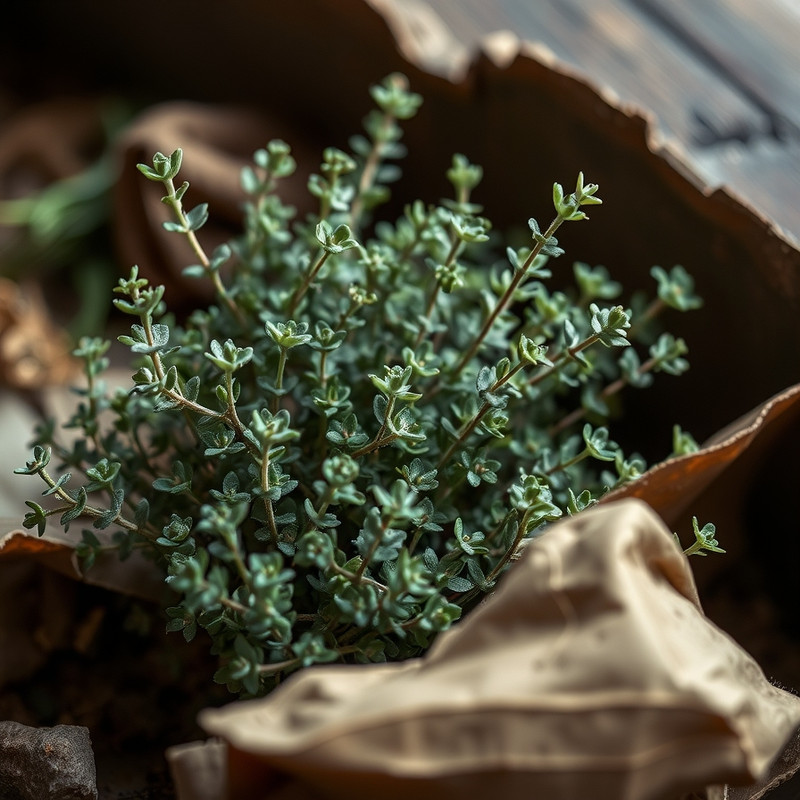
Thyme
Description
A small, branching shrub, 20-40 cm tall. It is characterized by its small, lanceolate leaves with rolled edges. Its flowers are small and white or pink, grouped in heads.
Key Properties & Benefits
It is highly antiseptic, antitussive, carminative, spasmolytic and anthelmintic. Its properties are mainly due to its essential oil, which contains thymol and carvacrol. It is also a diuretic and toning.
Basic Uses
It is used to treat respiratory conditions (cough, bronchitis, whooping cough) and intestinal infections, flatulence, colic, and dyspepsia. It is also used for gastroenteritis and as an antifungal.
Cultural Significance
It is one of the main antiseptic plants and is widely used in cooking and traditional medicine. Thyme has a cultural significance closely linked to courage, strength, and purification. In ancient Greece and Rome, thyme was associated with bravery and fortitude, and warriors often carried sprigs of thyme to enhance their fearlessness.
Spiritual & Ceremonial Use
In Celtic culture, thyme was another sacred plant, used to purify spaces before ceremonies, and in Ireland and Scotland, thyme infusion is called "fairy tea," a belief that attributes to it the power to connect with spiritual beings in dreams. The name thyme derives from the Greek "thymos," a word meaning soul, vital energy, and courage, which reinforces its symbolism. In general, thyme is seen as a symbol of courage, strength, serenity, and purification, as well as being a highly regarded healing plant in various Mediterranean and European cultures.
Preparation Methods
Internal Use: It is commonly prepared as an infusion or decoction. It is also used in syrups (Compound Thyme Potion) and as a fluid extract (Antitussive Drops). Inhalation Use: It can be used for antiseptic steam inhalations (smudge sticks) to clear the airways.
Dosage Guidelines
Infusion/Decoction: 1-2 g/cup, administered 2-3 times a day after meals, for 4-5 weeks. Antitussive Drops: 30 drops of Thyme Fluid Extract are recommended, 4 to 6 times a day. Chest Infusion: Dissolve one teaspoon of extract in a cup of warm water, 3-4 cups a day.
Precautions & Warnings
The essential oil is an irritant. Thymol, one of its main components, can be hepatotoxic in very high doses or with prolonged use. It is listed as a plant with a toxic essential oil if used in doses higher than recommended.
Ethical Harvesting
The aerial part (flowering tops) is collected at the beginning of flowering and dried quickly in the shade at a temperature below 45°C.