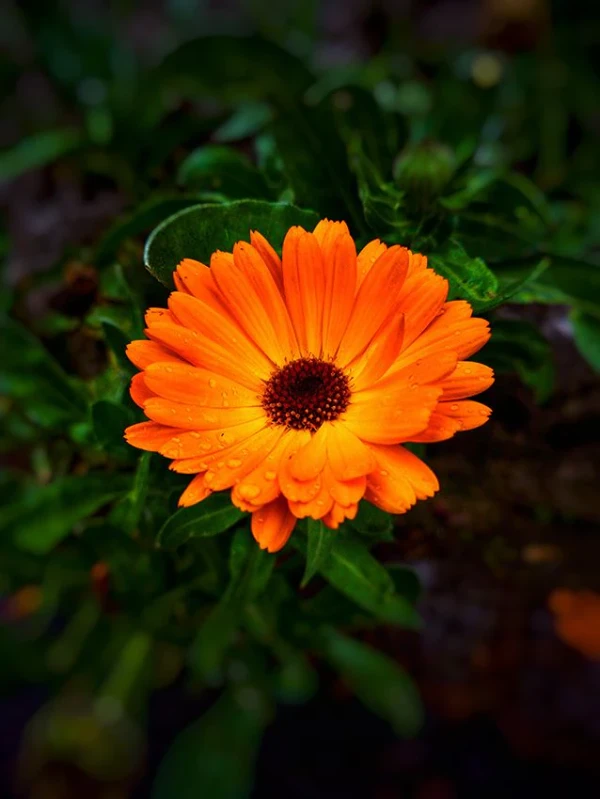
Calendula
Description
An aromatic annual herb that can grow up to half a meter tall, or 30 to 60 cm high. It has a branched, angled, and hairy stem. Its flowers (heads) are large, 3-5 cm in diameter, with tubular central florets surrounded by several rows of ray florets (petals). The flowers can be yellow or orange. The leaves are alternate, hairy, and have toothed margins.
Key Properties & Benefits
Regulates menstruation and relieves pain; it is also purifying, antiseptic, and healing. It is attributed with antiseptic, carminative, purifying, emmenagogue, spasmolytic, insecticidal, febrifuge, laxative, sedative, tonic, and vermifuge properties.
Basic Uses
External (topical) use: Skin conditions, ulcers, sores, mastitis, burns, scalds, pimples, athlete's foot, and vaginal washes. Internal use: To treat diarrhea, pain, colds, parasites, and bilious and nervous conditions. It is used to prevent asthma and migraines, and during childbirth and for dysmenorrhea. It is also used for stomach and duodenal ulcers, gastritis, hypertension, and hepatobiliary conditions.
Cultural Significance
It has been used traditionally since the time of Dioscorides. It was introduced to America as an ornamental and medicinal plant.
Spiritual & Ceremonial Use
Ceremonially, in cultures such as India, it is used in garlands for weddings and religious rituals, where its presence symbolizes light, opportunity, and abundance. In Greek mythology, it is associated with the tears of Aphrodite, symbolizing that light and spiritual growth can emerge from sad experiences.
Preparation Methods
External use: In baths, with at least 20 flowers per liter of water. Also in poultices, oil, or ointment. It is also applied in washes, compresses, mouthwashes, vaginal or anal irrigations, and enemas. Internal use: Infusion of the fresh or dried plant.
Dosage Guidelines
Internal use (Infusion): 1-3 g/cup, administered 2-3 times/day. Other oral preparations: 100-300 mg/capsule of powder, 2-5 ml of 1:5 tincture, 0.2-0.6 mg/day of parthenolide equivalents. External use (Infusion/Decoction): 50-60 g/L in infusion. Baths/Poultices: At least 20 flowers per liter of water.
Precautions & Warnings
The plant is not toxic. Excessive use may cause abortion. The flowers may cause contact dermatitis and allergies.
Ethical Harvesting
It is cultivated in gardens and orchards. The first cutting of flowers and leaves is taken when it blooms (March-September), which can be repeated 2-3 times a year. Fresh material is preferred for infusions, but if drying, it should be done in the shade.