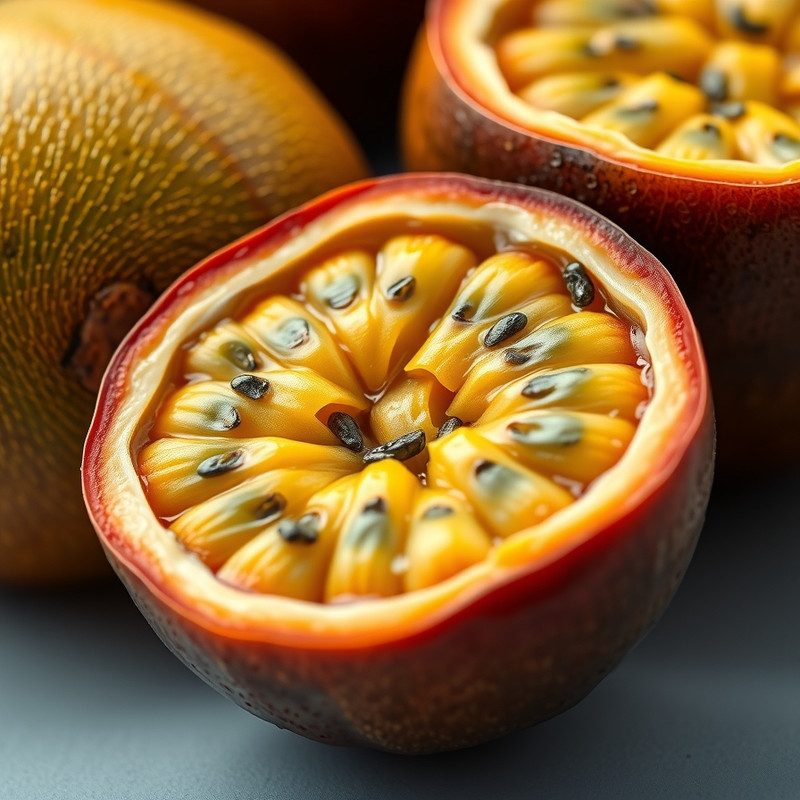
Passion fruit
Description
Planta herbácea trepadora, glabra, con tallos leñosos de hasta 9 metros de longitud. Las hojas son alternas, trilobuladas y de color verde oscuro. Las flores son vistosas, cremosas con tintes rosados pálidos, o blancas y de hasta 7 cm de ancho. Sus frutos fragantes son ovoides globulares, de 4-5 cm de largo, de color amarillo verdoso o púrpura.
Key Properties & Benefits
Se le atribuye propiedad ansiolítica, sedante, diurética, febrífuga y antihipertensiva. Experimentalmente, la infusión de hojas de P. edulis demostró actividad sedante y potenciación de barbitúricos, aunque no ansiolítica.
Basic Uses
Medicinal: Treatment of bronchitis, asthma, anemia, epilepsy, insomnia, hypertension, and other nervous conditions (oral use of leaves and flowers). The fruit juice is used to treat jaundice, stomach aches, and intestinal tumors. Topical: Used for hemorrhoidal inflammation. Edible: The fruit juice is used as a beverage and to treat jaundice.
Cultural Significance
The flower of this genus impressed Spanish explorers, who believed they saw nails, hammers, and other instruments of crucifixion, giving it the name "Passion Fruit".
Spiritual & Ceremonial Use
Passion fruit has significant spiritual and ceremonial uses in several Latin American cultures. Spiritually, the fruit is associated with inner peace, relaxation of the nervous system, and serenity, thanks to its naturally calming properties. It is used in rituals and offerings to attract positive energy, fertility, and protection, as well as representing passion and connection to higher states of consciousness. Ceremonially, passion fruit is part of Indigenous and Afro-Brazilian celebrations, where it is offered to the gods in rituals to ask for abundance, health, and well-being. In Andean religion, for example, it is incorporated into the Inti Raymi festival to honor the sun and nature. Its flower, the passionflower, is also valued for its symbolism related to the Passion of Christ and profound spirituality.
Preparation Methods
It is used in infusions of leaves and flowers. The juice of the fruit is used orally.
Dosage Guidelines
Tea or infusion: It can be prepared with 1 teaspoon of dried leaves or 2 teaspoons of fresh leaves in 150 ml of boiling water, taken up to 4 times a day to treat insomnia or anxiety. Tincture: The common dose is 2 to 4 ml (40 to 80 drops) diluted in water, 3 times a day, as directed by a physician. Fluid extract: 2 ml (about 40 drops) is recommended 3 times a day, diluted in water. Capsules: Typically, 1 to 2 capsules of 200 mg are taken in the morning and at night under professional supervision. Dried leaf and stem extract: Dosage of 1 to 5 grams, 3 to 4 times a day.
Precautions & Warnings
The use of the plant is generally safe.
Ethical Harvesting
It is a plant that is not widely cultivated in Guatemala, even though the conditions are right. The leaves and tender flowers are harvested during fruiting and immediately dried in the shade.